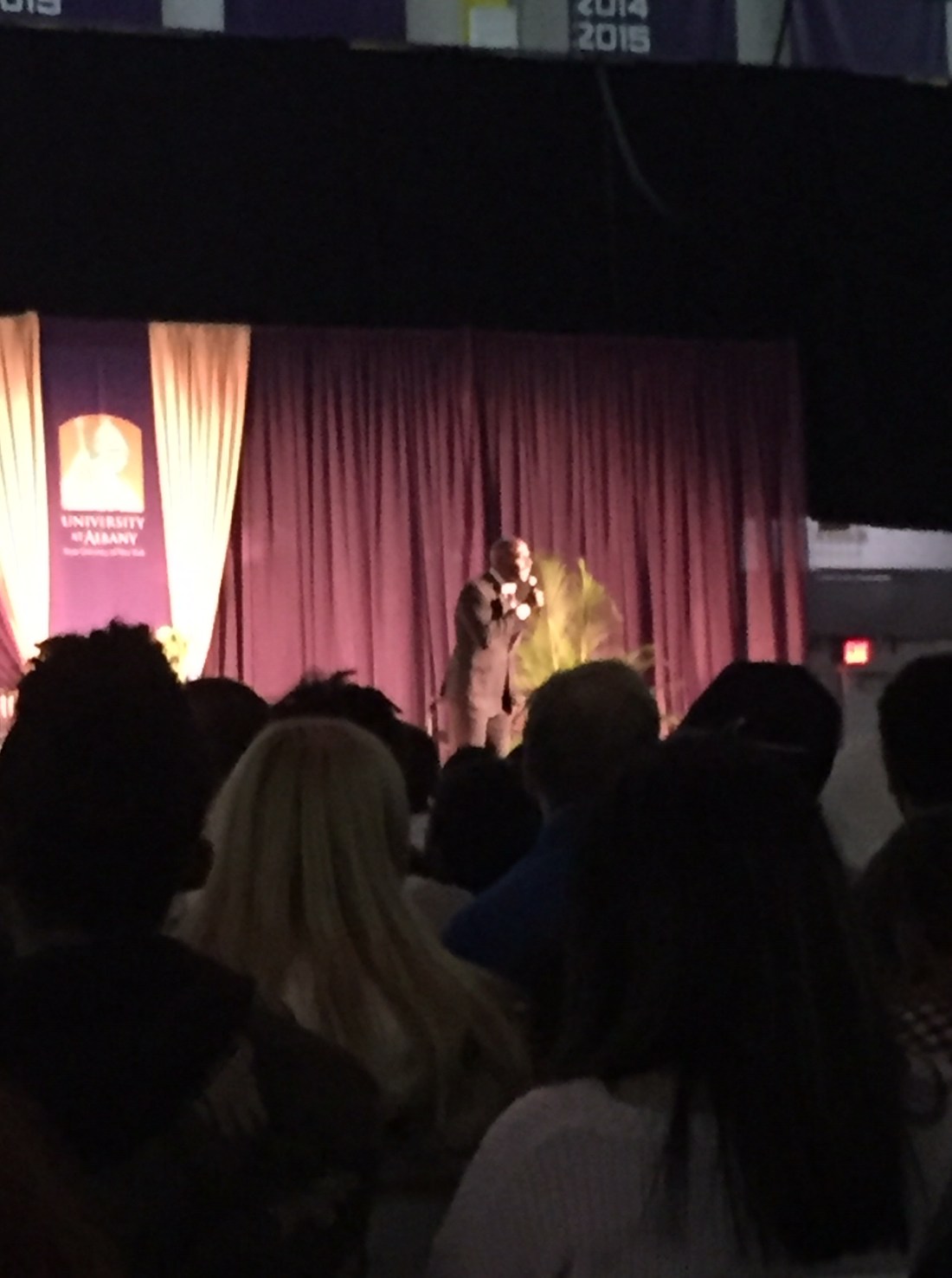
When people think of influential figures in today’s society, most people can name someone. Michelle Obama is a prominent example for her charitable work, as well as Bill Gates and his wife to help end world hunger around the world with the help of his wife. But one person that does not usually come to people’s minds, just recently stopped at the University at Albany, to give a valuable presentation, with advice that young college students might need to hear. That person is Terry Crews.
Growing up in Flint, Michigan, his father was not exactly the best role model for a young child, as Crews told the audience that he witnessed his father beating his mother at the early age of four. From that day on, Crews started to accept the idea that women were less valuable than men, and how men could use their power to abuse women with impunity.
“Who would have thought that a guy with this much prominence would be humbled about the truths of life in a little over a decade after he quit football,” said Jared Moss, a freshman student who attended the event.
6 years after being drafted in the 1991 NFL Draft, Crews retired from professional football in 1997 and moved to Los Angeles to pursue his lifelong dream of working in the film industry. Crews told how his first role that he landed was on a game show called Battle Dome. After years of hard work and dedication, Crews eventually became a household name, after appearing in The Longest Yardand Are We There Yet? Where he was nominated for outstanding actor in a comedy series at the NAACP Image Awards. Crews felt like he was “on top of the world” after being able to achieve his lifelong dream.
This all changed in 2016, when the actor attended a Hollywood party and was groped repeatedly by an executive at his talent agency (Crews did not share his name), in which Crews tried to avoid conflict and shove him away. Crews stated that he felt depressed on that night about the way he handled the situation, and after receiving support from his wife, decided to go to therapy to work things out.
The therapy helped him transform his train of thought as a rich, Hollywood actor, playing a role model on young people. As Crews went on, he noted that if the incident had not happened at the party, he “would not be speaking on stage today in front of these great people.” Crews experienced something new and shocking in his life, differentiating from his childhood and finally admitting that his perception was wrong.
Alex Goldfeder, another freshman at UAlbany who witnessed Crews tell his story stated that “he’s a trendsetter. Most men would not want to come out and share their stories, since the media focused at first on the Weinstein allegations and women sharing their stories, but I think Crews was the first prominent figure to show the reality that it can happen to anyone.”
Concluding his talk, Crews said it was important for him to continue to be open about his personal experiences. Crews answered a few questions after his informal speech, before leaving to a round of applause for his influential comments.
Human Sources: Jared Moss, UAlbany Student, jmoss@albany.edu
Alexandra Goldfeder, UAlbany Student, agoldfeder@albany.edu
 Ben's Blog